How Long Does It Take to Learn Guitar? A Realistic Timeline by Skill Level
Hour-by-hour and month-by-month expectations for learning guitar, from your first chord to performing, with the factors that speed the process up or slow it down.
Quick answer
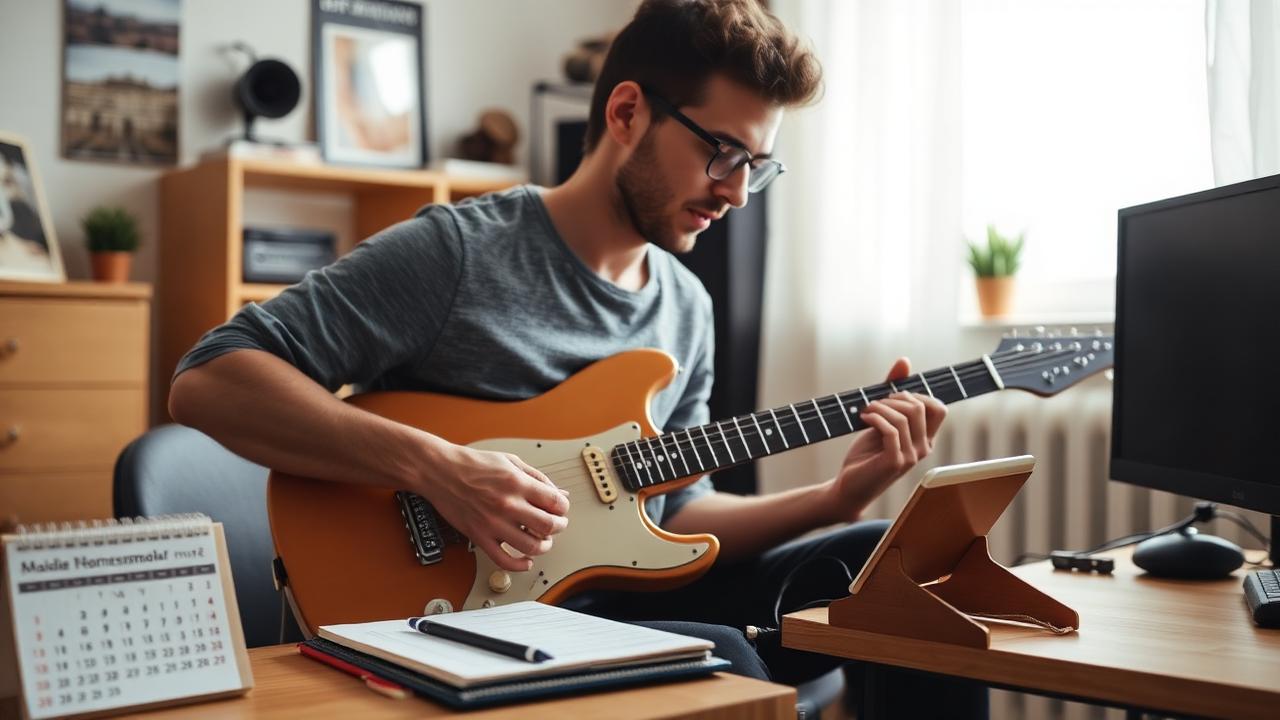
With 20 to 30 minutes of practice five days a week, most people play their first recognisable song in 2 to 4 weeks, sound comfortably like a beginner guitarist at around 3 to 6 months and 100 to 150 total hours, and reach a solid intermediate level in 1.5 to 2 years and roughly 600 to 800 hours. Consistency matters far more than session length: five 20-minute sessions beat one 2-hour session, and weekly feedback from a teacher typically cuts the timeline by 30 to 50 percent by preventing habits that later have to be unlearned.
The honest answer: it depends on hours, not months
Guitar progress tracks accumulated focused practice hours, not the calendar. Someone practising 15 minutes a day for a year logs about 90 hours; someone practising 45 minutes a day logs about 270 hours in the same year and will be at a visibly different level.
Because of that, it is more useful to think in hour bands than in months. The table below converts the common milestones into both, assuming 5 practice days a week.
| Level | Total hours | At 20 min/day | What you can do |
|---|---|---|---|
| First chords | 5-10 | 2-3 weeks | Hold Em, Am, C cleanly and switch slowly |
| First song | 15-25 | 1-2 months | Play a 2-3 chord song end to end with a simple strum |
| Confident beginner | 100-150 | 6-9 months | Play 10+ songs, use a capo, basic fingerpicking |
| Early intermediate | 300-400 | 1.5-2 years | Barre chords, scales, play with others, learn songs by ear |
| Solid intermediate | 600-800 | 3-4 years at 20 min | Improvise, perform, arrange, handle most pop repertoire |
| Advanced | 2000+ | Varies | Genre fluency, advanced technique, teaching or gigging |
Month-by-month: what the first year looks like
This is the trajectory we see most often with students taking one weekly live class plus 20 to 30 minutes of daily practice. Individual pace varies, but the order of milestones is remarkably consistent.
- Month 1: five open chords, one-minute change drills, first two-chord song, sore fingertips that settle by week three
- Month 2: D DU UDU strumming, first four-chord song, playing along to recordings
- Month 3: capo use, simple fingerpicking pattern, calluses fully formed, 5-6 songs in your repertoire
- Months 4-6: first barre chords, power chords, palm muting, minor pentatonic shape 1, playing without looking at the fretboard
- Months 7-9: full songs with intros and riffs, basic ear training, transposing with a capo, comfortable at 100+ bpm
- Months 10-12: barre chords in real songs, first solos, playing with a metronome or backing track, recording yourself
What makes people learn faster
Two learners with identical practice time can end up a year apart in ability. The differences are almost always in how the practice is structured rather than in talent.
| Factor | Effect on timeline | Why |
|---|---|---|
| Daily short practice | 30-40% faster | Motor skills consolidate through frequency, not duration |
| Weekly teacher feedback | 30-50% faster | Errors are caught before they become automatic habits |
| Metronome use | 20-30% faster | Timing improves alongside technique instead of after it |
| Playing full songs | Meaningful | Context forces transitions, dynamics, and endurance |
| Recording yourself weekly | Meaningful | You hear what a listener hears, not what you intend |
| Prior music experience | 10-25% faster | Rhythm reading and ear skills transfer across instruments |
What slows people down
Almost every stalled guitarist we meet is losing time to the same handful of issues, and most are fixable in a single lesson.
- Practising only on weekends, which resets muscle memory between sessions
- Playing the same three songs you already know instead of adding new material
- Skipping rhythm work, so chord shapes are clean but the playing does not groove
- An unplayably high action or badly set-up guitar, which makes fretting far harder than it should be
- Attempting barre chords in week two and concluding you are not musical
- Jumping between tutorials with no structured sequence or weekly target
Does age change the timeline?
Adults are not too late, and children are not automatically faster. Children usually pick up ear skills and finger flexibility more easily; adults understand structure, self-correct better, and practise more deliberately once they commit.
The practical difference is in session design. Children do better with two short sessions and gamified targets; adults do better with a single focused block and clear weekly outcomes.
| Age group | Typical time to first song | Best session length | Notes |
|---|---|---|---|
| 6-9 years | 4-8 weeks | 10-15 min, twice daily | Nylon or small-body guitar, heavy focus on games and songs |
| 10-16 years | 2-4 weeks | 20-30 min | Motivation follows repertoire they actually listen to |
| Adults 18-45 | 2-4 weeks | 20-40 min | Fastest structured progress when practice is scheduled |
| Adults 45+ | 3-6 weeks | 20-30 min | Slightly longer for finger flexibility; endurance builds normally |
How to shorten your own timeline
If you want to compress the first year, the highest-return changes are structural rather than about practising more.
- Set a fixed practice time and treat it like a meeting rather than a mood-dependent activity
- Split every session: 5 minutes technique, 10 minutes new material, 5 minutes a song you enjoy
- Use a metronome from week one, starting slower than feels necessary
- Get your guitar professionally set up so the action is comfortable
- Book weekly feedback so errors are caught within days, not months
- Record a 60-second video every Sunday and compare monthly
Frequently Asked Questions
How long does it take to learn guitar for a complete beginner?
Most complete beginners play a simple two or three chord song within 2 to 4 weeks at 20 minutes of daily practice, and feel like a confident beginner at around 100 to 150 total practice hours, which is roughly 6 to 9 months at that pace.
How many hours a day should I practise guitar?
Twenty to thirty minutes a day, five days a week, is the sweet spot for beginners. Frequency drives motor learning more than duration, so daily short sessions outperform one long weekend session of the same total length.
Can I learn guitar in 3 months?
In three months of consistent daily practice you can expect to play five or six songs with open chords, a capo, and a couple of strumming patterns. You will not have barre chords or soloing yet, but you will be genuinely playing music.
Is guitar harder than piano to learn?
Guitar is harder in the first month because of fingertip pain and chord shapes, while piano is easier to make an immediate pleasant sound on. Beyond a year the difficulty evens out, with piano demanding more two-hand independence and guitar more physical technique.
Is 30 or 40 too old to learn guitar?
No. Adults typically progress faster than children in the first year because they practise deliberately and understand structure. Finger flexibility takes slightly longer to build, which a good warm-up routine addresses.
How long until my fingers stop hurting?
Fingertip soreness usually peaks in week one and settles by weeks three to four as calluses form. Playing a little every day builds calluses faster than occasional long sessions, which just cause blisters.
Do guitar lessons make you learn faster than self-teaching?
Typically yes, by around 30 to 50 percent, mainly because a teacher corrects posture, timing, and hand position before they become habits. Self-teaching works, but time lost to unlearning errors usually exceeds the lesson time saved.
How long does it take to learn barre chords?
Most learners get a usable F barre chord between month three and month five, after their open chords are reliable. Attempting barres much earlier is the single most common reason beginners quit.
Want a realistic plan for your own timeline?
Book a free trial guitar class and get an honest assessment of your current level plus a month-by-month roadmap built around the practice time you actually have.
Related Articles
Online Piano Lessons FAQs: Cost, Practice Time, and Results
A practical FAQ guide for students and parents comparing online piano lessons by outcomes, routine, and teacher quality.
Read articleOnline Guitar Lessons FAQs: Beginner Roadmap, Cost, and Setup
Top questions from beginner guitar students covering class format, progress speed, and how to avoid common early mistakes.
Read articleHow to Learn Guitar: Complete Beginner Guide for First 90 Days
A complete step-by-step roadmap for learning guitar from scratch, including routine, song strategy, and mistake fixes.
Read article