Guitar Chords for Beginners: The Complete Chart, Finger Positions, and Practice Order
Every open chord a beginner needs, with fret-by-fret finger positions, which strings to avoid, the chord families that sound good together, and the order to learn them in.
Quick answer
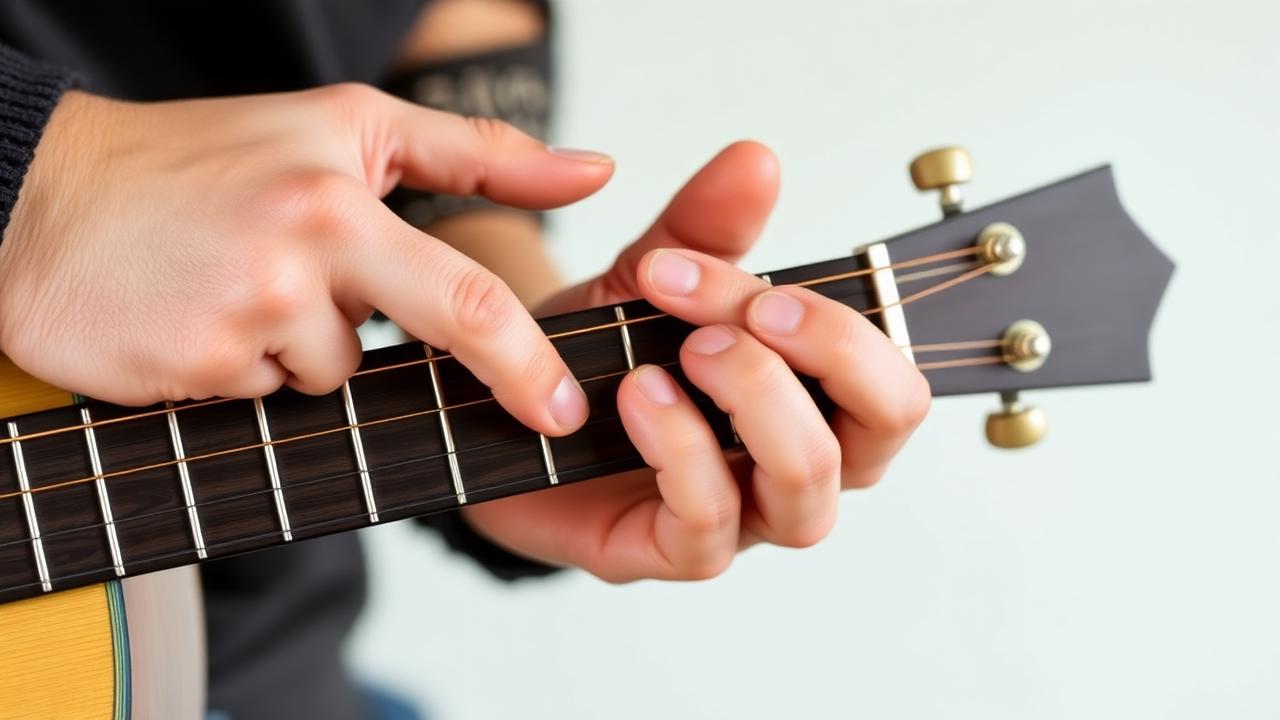
There are eight open chords every beginner should learn first: Em, Am, E, A, D, C, G, and Dm. Learn them in that order, because each one adds one new finger movement rather than a whole new shape. Fret notes just behind the metal fret with the fingertip, keep the thumb behind the neck, and check every string rings by picking them one at a time. Expect two to three weeks to hold all eight cleanly and four to six weeks to change between them in time. Delay the F barre chord until your open chords are reliable, and use Fmaj7 or a capo until then.
How to read a chord chart
A chord chart shows the first four or five frets of the guitar as a grid. Vertical lines are strings, from the thickest low E on the left to the thinnest high E on the right. Horizontal lines are frets, with the nut at the top.
Numbers tell you which finger to use: 1 is the index, 2 the middle, 3 the ring, and 4 the little finger. An O above a string means play it open, and an X means do not play that string at all.
- Strings, low to high: E A D G B e (6th to 1st)
- Finger numbers: 1 index, 2 middle, 3 ring, 4 pinky
- O = play open, X = mute or skip that string
- Press just behind the fret wire, not on top of it and not halfway back
- Arch your fingers so the fingertip, not the pad, contacts the string
The eight essential open chords, string by string
Each row below describes where each finger goes and which strings to strum. Fret positions are written as string/fret pairs, counting strings from 6 (low E) to 1 (high e).
| Chord | Finger positions | Strum strings | Learn in |
|---|---|---|---|
| E minor (Em) | 2nd finger: 5th string, fret 2. 3rd finger: 4th string, fret 2 | All 6 | Day 1 |
| A minor (Am) | 1st: 2nd string fret 1. 2nd: 4th string fret 2. 3rd: 3rd string fret 2 | Strings 5-1 | Day 1 |
| E major (E) | 1st: 3rd string fret 1. 2nd: 5th string fret 2. 3rd: 4th string fret 2 | All 6 | Day 2 |
| A major (A) | 1st, 2nd, 3rd fingers all on fret 2 of strings 4, 3, 2 | Strings 5-1 | Day 3 |
| D major (D) | 1st: 3rd string fret 2. 2nd: 1st string fret 2. 3rd: 2nd string fret 3 | Strings 4-1 | Week 1 |
| C major (C) | 1st: 2nd string fret 1. 2nd: 4th string fret 2. 3rd: 5th string fret 3 | Strings 5-1 | Week 2 |
| G major (G) | 2nd: 6th string fret 3. 1st: 5th string fret 2. 3rd: 1st string fret 3 | All 6 | Week 2 |
| D minor (Dm) | 1st: 1st string fret 1. 2nd: 3rd string fret 2. 3rd: 2nd string fret 3 | Strings 4-1 | Week 3 |
Chord families that sound good together
Chords are easier to remember when you learn them as a key rather than as isolated shapes. Each key below gives you a full song without touching a barre chord.
If a song is in a key with awkward chords, put a capo on and use a friendlier family. A capo on fret 2 with G-family shapes gives you the key of A, for example.
| Key | Main chords | Typical songs | Capo tip |
|---|---|---|---|
| G major | G, C, D, Em, Am | Country Roads, Knockin' on Heaven's Door | Capo 1 for Perfect |
| C major | C, F/Fmaj7, G, Am, Dm | Let It Be, Someone Like You (capo 2) | Use Fmaj7 instead of F |
| D major | D, G, A, Bm, Em | Three Little Birds, Wonderwall (capo 2) | Capo 2 turns Bm into Am |
| A minor | Am, G, F, C, Dm, E | Riptide, Channa Mereya, Kabira | Capo 1-2 for most ballads |
| E minor | Em, C, G, D, Am | Eleanor Rigby, Boulevard of Broken Dreams | No capo needed |
The F chord problem, and three ways around it
The F major chord ends more beginner guitar journeys than any other single obstacle, because the full barre needs finger strength that simply has not developed yet in month one. You do not have to fight it immediately.
Build up in stages instead. Each version below sounds acceptable in a song, so you can keep playing music while the strength arrives.
- Fmaj7: 1st finger 2nd string fret 1, 2nd finger 3rd string fret 2, 3rd finger 4th string fret 3, strum strings 4 to 1
- Mini F: same as Fmaj7 but bar strings 1 and 2 at fret 1 with the index finger
- Capo swap: put a capo on fret 1 and play E shapes, which removes F entirely from many songs
- Full barre F: index bars all six strings at fret 1, plus the E major shape two frets up
- Barre readiness test: your index finger can bar strings 1, 2, and 6 cleanly at fret 5 before you try fret 1
Chord change drills that actually work
Holding a chord is a static skill. Playing music is a moving skill. The gap between them closes with timed change drills, not with more repetitions of the same shape.
Set a timer for one minute per chord pair and count how many clean changes you make. Write the number down. Beginners typically start at 15 to 20 changes a minute and reach 60 within a month.
- One-minute changes: alternate two chords for 60 seconds, count clean swaps, log it
- Ghost changes: lift and reform the shape above the strings without strumming
- Anchor fingers: keep any shared finger down between chords, for example C to Am
- Slow metronome loop: one strum per bar at 60 bpm, change every bar, no stopping
- Strum-through: keep the right hand moving even if the left hand is late
- Song context: apply the pair inside a real song within the same session
How long each stage takes
These are typical ranges for a learner practising 20 minutes a day, five days a week, with weekly feedback from a teacher. Self-taught learners usually take 30 to 50 percent longer because errors go uncorrected.
| Milestone | With weekly guidance | Self-taught | Practice per day |
|---|---|---|---|
| Hold Em and Am cleanly | 2-4 days | 1 week | 15-20 min |
| Five open chords held cleanly | 2-3 weeks | 4-6 weeks | 20 min |
| 60 clean changes per minute | 4-6 weeks | 2-3 months | 20 min |
| Play a 4-chord song with strumming | 4-8 weeks | 3 months | 20-30 min |
| Clean F barre chord | 3-5 months | 6+ months | 20-30 min |
Frequently Asked Questions
What are the basic guitar chords for beginners?
Em, Am, E, A, D, C, G, and Dm. These eight open chords cover the vast majority of beginner songs and need no barre technique. Learning them in that order adds one new finger movement at a time.
Which guitar chord should I learn first?
E minor. It uses only two fingers, both on the same fret, and lets you strum all six strings, so it is the fastest chord to make sound good on day one.
Why do my guitar chords sound buzzy or muted?
Usually one of four causes: pressing too far behind the fret, fingers lying flat and touching neighbouring strings, not enough pressure, or a thumb wrapped over the top of the neck. Pick each string one at a time to find which one is dead, then adjust that finger.
How long does it take to learn guitar chords?
Most learners hold five open chords cleanly within two to three weeks at 20 minutes a day, and change between them in time within four to six weeks. Barre chords typically take three to five months.
How do I change chords faster?
Use one-minute change drills between two chords, keep any shared anchor finger planted, move all fingers as one shape rather than one at a time, and never stop the strumming hand while the left hand catches up.
Is the F chord necessary for beginners?
Not immediately. Fmaj7 or a capo covers most songs for the first few months. Add the full barre F once your index finger can bar cleanly at fret 5, which usually happens around month three.
How many chords do I need to play most songs?
Four. The I-V-vi-IV progression, which is G, D, Em, C in the key of G, underpins a very large share of popular music across pop, folk, country, and Bollywood ballads.
Should my thumb be behind the neck or over the top?
Behind the neck, roughly opposite your middle finger, for open chords and barre chords. Hooking the thumb over the top is a legitimate advanced technique but it flattens your fingers and mutes strings while you are learning.
Get your chord shapes checked before bad habits set in
Book a free trial guitar class and have a mentor watch your hand position live, diagnose buzzing strings, and set your chord-change targets for the month.
Related Articles
Online Piano Lessons FAQs: Cost, Practice Time, and Results
A practical FAQ guide for students and parents comparing online piano lessons by outcomes, routine, and teacher quality.
Read articleOnline Guitar Lessons FAQs: Beginner Roadmap, Cost, and Setup
Top questions from beginner guitar students covering class format, progress speed, and how to avoid common early mistakes.
Read articleHow to Learn Guitar: Complete Beginner Guide for First 90 Days
A complete step-by-step roadmap for learning guitar from scratch, including routine, song strategy, and mistake fixes.
Read article