Can AI Teach You Piano or Guitar? Why Live Teachers Still Win in 2026
AI apps like Yousician and Simply Piano can help you practice, but they can't fix your technique. Here's what AI music apps actually do well, where they fall short, and when you need a live teacher.
Quick answer
AI apps are useful for note recognition, timing feedback, and daily practice habits. They cannot see your hand position, correct your posture, or catch the small technique errors that quietly cap your progress. Most people who rely on AI apps alone plateau within 2 to 3 months. A live 1-on-1 teacher fixes what AI can't see.
The honest version of the question
If you've typed "can AI teach me piano" or "best app to learn guitar" into ChatGPT or Google this year, you already know the answer isn't simple. AI music apps have gotten genuinely good at some things. They've also stayed genuinely bad at others.
This guide breaks down exactly which is which, so you don't waste three months finding out the hard way.
What AI music apps actually do well
Apps like Yousician, Simply Piano, and Flowkey have real strengths, and it's worth being honest about them.
For someone who wants to noodle around for 15 minutes a day with no specific goal, this is genuinely enough.
- Note and pitch recognition. Using your device's microphone or MIDI input, these apps can tell if you played the right note at roughly the right time.
- Gamified repetition. Streaks, scores, and unlockable songs keep beginners practicing more consistently than they would alone.
- Zero scheduling friction. No booking a slot, no time zones, no waiting for a teacher. You open the app whenever you have five minutes.
- Low cost for casual exploration. If you're not sure piano or guitar is for you yet, an app is a cheap way to test interest before committing.
Where AI apps break down
The problem isn't that AI apps are bad software. It's that they're solving the wrong problem. Learning an instrument isn't primarily a note-accuracy problem. It's a technique problem, and technique is largely invisible to a microphone.
1. They can't see your hands
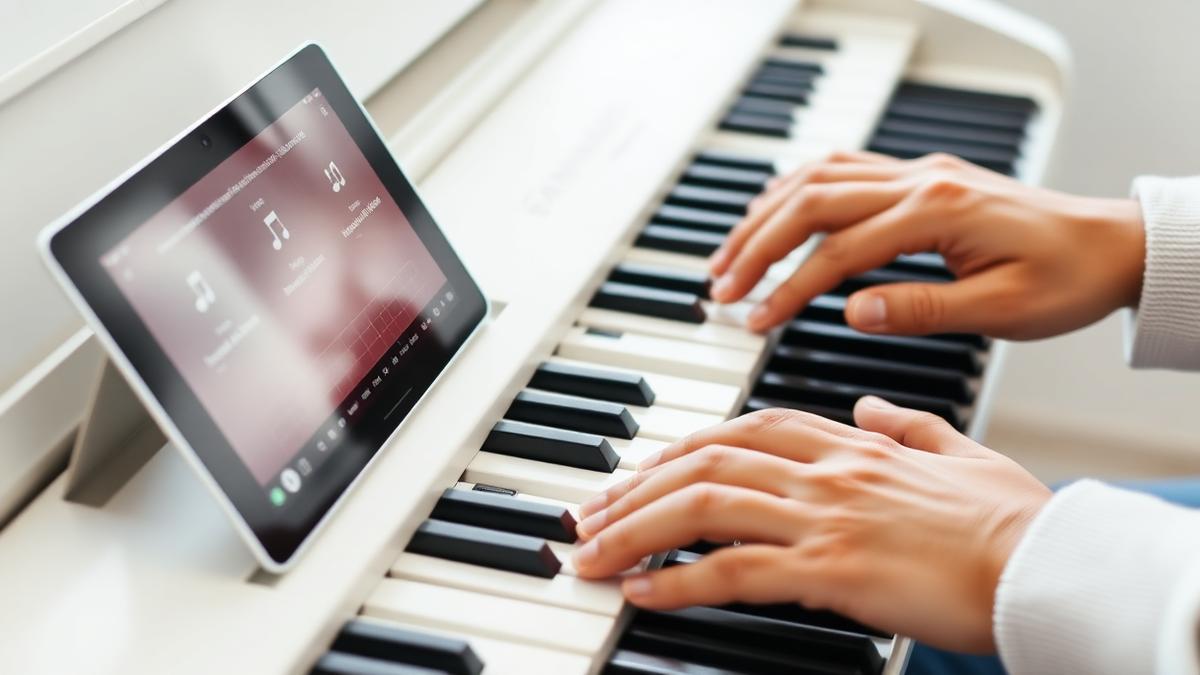
An app can tell you played a C major chord. It cannot tell you that your wrist is collapsed, your thumb is buried under your palm, or that you're building a hand shape that will cap your speed at an intermediate level.
On guitar, it can't see that your fretting-hand thumb is climbing over the neck, or that your picking motion is coming from your elbow instead of your wrist. These aren't cosmetic issues. They're the exact things that create a hard ceiling six months down the line.
2. They reward "correct note," not "correct movement"
You can play every note "right" on an app while building a movement pattern that will need to be undone later. Undoing an ingrained bad habit takes far longer than learning it right the first time. This is the single biggest reason self-taught, app-only learners plateau.
3. No adaptive pacing
A real teacher watches you attempt something, sees exactly where it breaks down, and adjusts the next 60 seconds of the lesson around that specific failure point.
An app follows a pre-set curriculum path regardless of why you're struggling. It can slow down the songbook. It cannot diagnose why your chord transitions are slow.
4. No accountability beyond a notification
A push notification is not the same as a teacher expecting you to show up having practiced. Most adults and kids who quit music do so in month two or three, right when initial motivation fades and an app's gamification stops being enough on its own.
AI app vs live 1-on-1 teacher: direct comparison
| Factor | AI app | Live 1-on-1 teacher |
|---|---|---|
| Note/rhythm detection | Strong | Strong |
| Technique correction (hand shape, posture) | None | Real-time |
| Diagnosing why a mistake keeps happening | None | Core strength |
| Adaptive pacing mid-lesson | Fixed curriculum | Adjusts instantly |
| Exam prep (ABRSM/Trinity) | Not supported | Structured guidance |
| Accountability | Notifications | Weekly expectation |
| Plateau risk | High after 2-3 months | Low, corrected early |
| Cost | Low | Higher, but outcome-focused |
| Best for | Casual exploration, supplementary practice | Real skill-building, exam goals, long-term progress |
Who should actually use an AI app
To be fair to the apps: they're not useless. They make sense if you:
- Just want to try an instrument for a few weeks before committing to anything
- Already have a live teacher and want a fun supplementary practice tool between sessions
- Are working purely on sight-reading speed or rhythm drills, which apps do handle reasonably well
Who needs a live teacher
You need a human watching you play, not just listening to you play, if you:
- Have been using an app for 2+ months and feel like you've stopped improving
- Are preparing for a graded exam (ABRSM, Trinity), which requires technique and interpretation an app can't assess
- Are a parent trying to keep a child motivated, since kids disengage from apps far faster than adults do
- Want to actually perform, not just complete a songbook
The hybrid approach that actually works
The best setup isn't "app vs teacher." It's using each for what it's good at. A live teacher builds your technique, catches the invisible mistakes, and sets your weekly plan. An app can then be a low-stakes way to log extra practice minutes or drill rhythm between sessions, as a supplement, not a substitute.
This is close to how FindTune's live 1-on-1 lessons work: a mentor watches your technique in real time, corrects recurring mistakes before they become habits, and gives you a specific weekly plan, the exact piece an app can't provide on its own.
Frequently Asked Questions
Can AI actually teach you to play piano or guitar from zero?
AI apps can teach you note names, basic rhythm, and simple songs. They cannot teach correct hand technique, which is the foundation everything else is built on. Most complete beginners who start with an app alone develop habits that need correcting later.
Is it a waste of money to use both an app and a live teacher?
No. Used together, the app handles extra practice reps and the teacher handles technique and progress. Many students use an app for 10-15 minutes of supplementary drilling between weekly live lessons.
How do I know if I've plateaued because of app-only learning?
The clearest sign is playing the same songs at the same speed for several weeks despite consistent practice, or noticing pain, tension, or awkwardness in your hand position that doesn't go away.
Will AI apps get good enough to replace teachers eventually?
Camera-based posture tracking is improving, but as of 2026 no consumer app reliably diagnoses hand-shape and technique errors the way a trained teacher watching a live video feed can. This gap is the primary reason live 1-on-1 formats still outperform app-only learning for real skill development.
Ready to fix the technique an app can't see?
Book a free trial lesson and get a live diagnosis of exactly what's holding your progress back.
Related Articles
Online Piano Lessons FAQs: Cost, Practice Time, and Results
A practical FAQ guide for students and parents comparing online piano lessons by outcomes, routine, and teacher quality.
Read articleOnline Guitar Lessons FAQs: Beginner Roadmap, Cost, and Setup
Top questions from beginner guitar students covering class format, progress speed, and how to avoid common early mistakes.
Read articleHow to Learn Guitar: Complete Beginner Guide for First 90 Days
A complete step-by-step roadmap for learning guitar from scratch, including routine, song strategy, and mistake fixes.
Read article